Dystopian Author Shares Insight into Debut Novel
Recently, I had the pleasure of sitting down with Tom O’Connell to discuss his debut novel, Lichtenberg, which was released in November of 2025. In the comfort of The Lane Café with a warm cup of coffee, I got to ask him all the questions that had been sitting at the forefront of my mind since I finished reading his book.
SS: Congratulations on your debut novel. I know it’s been a while since it came out, but it’s still a very impressive accomplishment. How are you feeling about having it published, and how was your experience with it?
TO: I was a few years trying to get it published, and everything I get to do in relation to it now is a privilege, really, any event where I get to talk about it or talk about fiction in general, anything that feels like working as a writer is really validating I suppose, so I enjoy talking about it. I think as I’m trying to focus on the sequel that I’m writing now, it can be a little bit difficult to be dragged back into this novel and thinking about the writing process, especially because it was a little while ago, to be out of the sequel and back in those earlier decisions, but it’s definitely a huge privilege that I get to go around talking about this novel.
SS: And you’re doing your PhD in dystopian literature; I imagine that’s quite difficult too while also writing?
TO: Yeah, it’s actually a practice-based PhD which means that half of it will be a traditional thesis but not quite as long as if that was the full basis of the PhD, and the other half is the sequel novel so that’s a contribution to it. So, it’s still tough, I’m breaking it down like I’ll do a month of academic writing and a creative writing month, so it’s still not as solid of a writing routine as I’d like it to be. But broadly I think I have more time to devote to writing than if I was doing this externally and trying to balance it with different things.
SS: What about dystopian literature made you want to pursue a PhD in it?
TO: I always kind of wrote short stories in that style, even before the novel. I think I liked envisioning high-concept worlds, but I don’t like writing about tech because I don’t really do hard science fiction. The kind of dystopia that I’ve been reading is mostly fantasy and I always liked the escapism of fantasy, but at the same time I ruminate on darker subjects and I think it blends the escapism sucking you into the world, but leaving you with the darker aspects that you’d be going around thinking about after finishing the novel, so I guess that’s the draw of the genre for me. Another reason I write dystopia is that it allows you to pare the world back so that you can focus on the characters’ relationships, and it’s logistically handy as well because there are fewer external references, like if you’re writing something set in the present day you might have random concerns like “why wouldn’t the UN intervene?” or something like that, but with post-apocalyptic worlds it's more imaginative. I guess mechanically it’s a lot easier to just focus on narrow character relationships.
SS: I know it’s a bit different now with your PhD, but do you have a specific writing process that you go through when you’re creating these worlds?
TO: I guess there are micro considerations - I don’t think I ever consciously decided I was world building now and this is exactly what it’s going to look like. It was kind of intentional little decisions about the way the propaganda worked or the structure of the Corps, and I think the world blossomed around those little decisions rather than me sitting down to world build. So, my process for creating these ideas would probably be pretty haphazard, like scribbled notes or notes in my phone, and then I’d flesh them out at home. I’d say my writing process at the moment is that on a good day I’ll be able to do it almost as a nine-to-five at my desk at university, but then on a bad day I’ll have an academic deadline, or I have a couple of part-time jobs, so it’s not as consistent as I would like it to be. Generally, with the creation, I guess, it’s more little decisions in the scraps of time that I have and then I’ll try and flesh them out when I have more time to return to them.
SS: I’ve experienced something similar with my writing as well, it’s kind of all over.
TO: Have you heard of Robin Hobb? I think it’s a pseudonym and she writes fantasy under that name, but I read an interview where she said how obsessive you have to be to be a writer, and it’s exactly like that, she’d have ten minutes in between giving her kids a bath or driving somewhere and because you’re narrowing it down to these little windows, you have to be obsessed about the idea the whole time in your head, so that when you get a chance to get it out you actually do.
SS: Was there anything in particular that you found really helped you in your writing process, something that pushed you through to get to publishing?
TO: The writing of the first one was strange, I’ve heard a lot of writers say you don’t really know how your first novel materializes. I didn’t even know that was going to be a finished novel, that was one of many projects at the time, it was just the first one I could sustain through to the end for whatever reason. I think now I have to define more of a writing process because I know what I have to finish and get to the deadline. But yeah, in terms of getting published, I definitely gained a lot of resilience, I guess I just kept saying to myself every time I got a rejection that it was not going to stop me. I suppose the process for me over those years was just trying to add as many strings to the bow of my query letter as possible, so that included entering things like the Irish Writer’s Centre’s Novel Fair, trying to send my short stories out there, even doing the master’s and now the PhD and just trying to legitimize myself as much as possible to get publishers and agents to the point where they would actually read beyond the query letter.
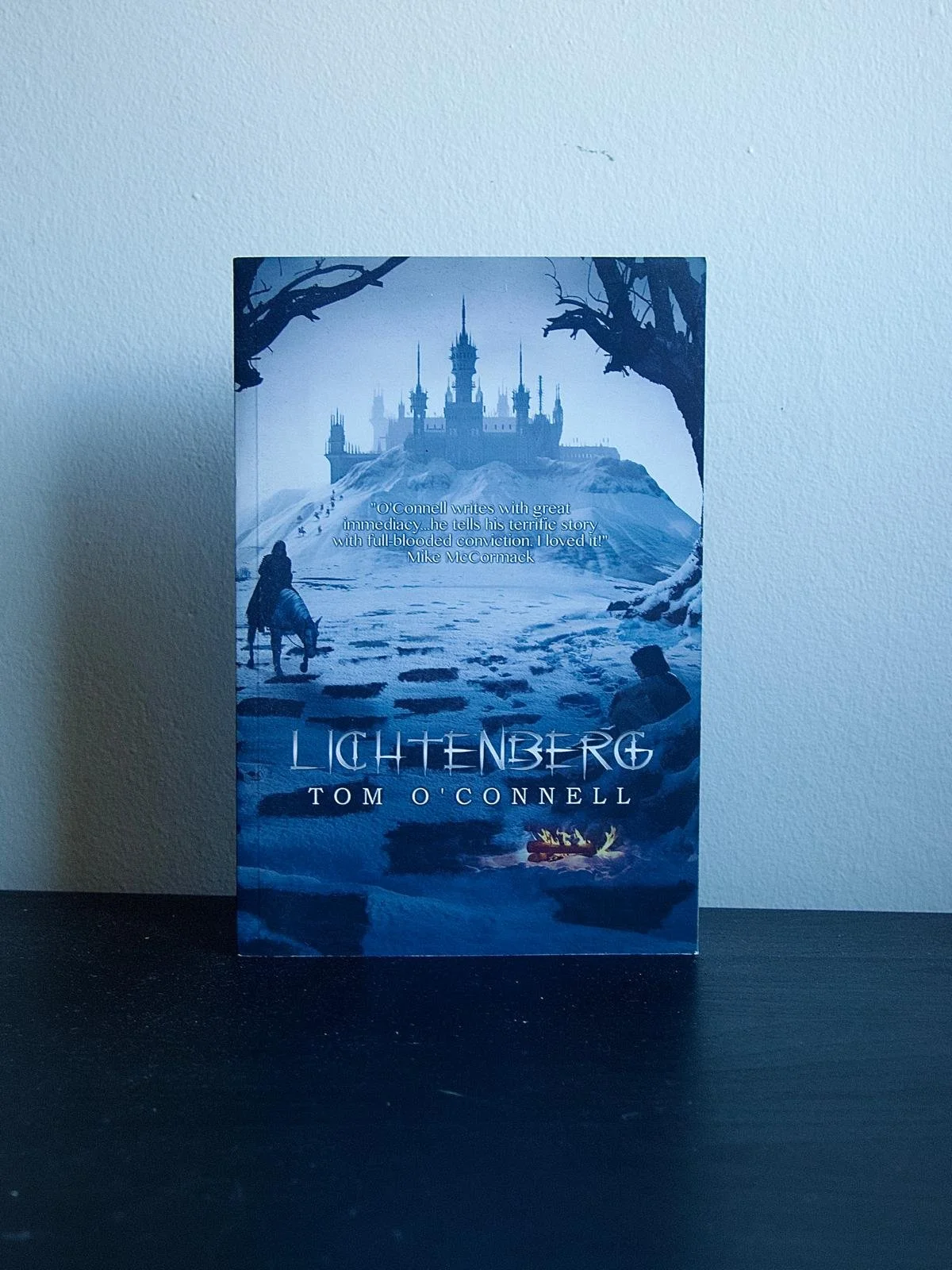
Lichtenberg was also selected as one of the winners for the Irish Writers Centre’s Novel Fair in 2023.
SS: I remember you had some success with the Novel Fair. Could you tell me about that a bit?
TO: I think they call it the International Debut Novel Competition now. Essentially you anonymously send a ten-thousand-word extract of your novel that has to be a finished manuscript, and they select twelve people to go the Writers Centre for a weekend of meeting with agents and publishers in fifteen-minute sessions. There’s also a couple of training days before that as well, where you’ll have some mentors and writers talking you through the process and how to pitch your novel. It was definitely a good qualification even if I didn’t get published directly out of that. I couldn’t even say how many I talked to, maybe thirty or forty, but a large portion of them didn’tpublish the genres I write in to begin with, and it didn’t materialize directly from those days. It was more that in future interactions where I would send queries, it was the first thing I could say, that this was a winner of a competition and I think that was probably one of the factors that ultimately interested Ron at Temple Dark. But on the day, you’re trying to distil your whole book into really a five-minute pitch because there was ten minutes ofconversation afterwards, so it was really tough, but to me it was the most important factor in getting published, and a huge honour to be selected in the first place.
SS: Especially when you’ve spent so long working on it and there have been so many pieces that haven’t made it to the final cut of the work, that are still floating around in your mind.
TO: It’s good for your thick skin though, even the training days, when I was giving query letter pitches they would bluntly tell me if something wasn’t interesting or wasn’t going to sell. In a cynical way you sort of need to make your book sound more like an existing bestseller rather than a more obscure book that you might love personally. That helps to define a category for it, like what books would be next to it on the shelf. It’s more commercial in that way. The actual couple of days were not as cynical as that; it was nice conversations about the writing.
At this point, I wanted to pivot to focus a bit more on his choices for such a genre-heavy book and how his experiences in publishing have been in regards to that.
SS: I think the topic of genre is very interesting, especially one like dystopian. I think I’ve heard that Ireland isn’t very big on genre-heavy works at times, how have you found that?
TO: I find almost that we have such a literary reputation that some genres are a bit looked down on. In my academic study I came across this man Jack Fennell, who did a study similar to mine but about Irish science fiction, and his whole opening thesis was that people don’t believe that such a thing as Irish science fiction exists and I still don’t know that it necessarily has a well-known or respected reputation. Generally, I probably would lump dystopiaand sci-fi together with some other things, but we had really strange-ish sci-fi in the twenties and thirties, immediately after we gained independence, it was almost non-science fiction, almost anti-intellectual stories, broadly expressing fear that we would get colonized again, or future societies where the monarchy is making a return. So, it seems like we did science fiction differently to the rest of the world because we had all these hangups of being a former colony. I definitely think there’s more experimental sci-fi and dystopia now, and Irish dystopia won the Booker prize three years ago. Another one just came out which was really good, by Neil Jordan, an Irish filmmaker, there’s also people doing more ‘classic’ sci-fi or speculative fiction now when it wasn’t so much of a thing quite a few decades ago.
SS: I was having a similar conversation with Al [A.M. Shine], about how hard it is to make your way with genre heavy works, especially in a literary industry that’s focused on literary fiction most of the time.
TO: It’s interesting as well, it might not have the literary reputation but Irish folklore is so rich with the kind of horror that he writes and in the same way I think I base a lot of my dystopias on our history with the British empire and that’s such a rich vein to explore. So it’s kind of a shame that it doesn’t have the solid reputation that it should have, but I think there’s so much in our history and culture that lends itself to these genres, and maybe not enough writers are practising them quite yet.
SS: I agree. I think there are many times where dystopia reflects what we know, and I think there is a huge misconception of dystopia as just this world that would never happen, but it’s rooted in truth and history.
TO: Yes, I think so. I rooted it in history, and since I’ve written it, it’s weird the amount of parallels I see presently. Specifically in the months after it came out I was seeing so many headlines about the way ICE was operating in the US, that were sometimes almost one-to-one scenes I had described, which at the time I thought were exaggeratedly bleak and brutal. So yeah, I think I would have taken inspiration from history but then to see it repeated in the present day reaffirmed the truth of it.
SS: I was going to ask if there were any particular political instances that really influenced your novel?
TO: It wouldn’t be a political influence, but it is classic Irish science fiction in that way, that it’s a paranoid invasion fantasy, because that’s basically how we expect our people to be colonized again. I wouldn’t say the city in the novel is a perfect stand-in for either Ireland or the UK, but there are a lot of nods to the shared history there.
Tom then explained that a segment he included in his novel that was a retelling of something that happened to Daniel O’Connell, who was a big historical figure pre proper independence.
I kind of based the ending on these independence fighters called the Irish Republican Brotherhood or the Fenians. A lot of our freedom fighters would have been poets and teachers and historians, and I think you can kind of see that almost romantic energy in some of their plots. There was one plot that I took a lot of inspiration from that was an attempt to draw the British police out of Dublin and claim the capital, and that’s not how it panned outat all, so I guess the almost – naivety is the wrong word – but romantic notions of rebellion, I would have taken a lot of inspiration from Irish history. But generally, there’s loads of colonial stuff in there, I think wherever I do internal justification for the xenophobia and the Ramasites, I would have taken things like phrenology, the idea that the British elite had different skull shapes than us, any of those pseudoscientific, irrational justifications.
SS: I think that came through very clearly, the idea that the Ramasites are a different species even though they are humans.
TO: The word Ramasite was probably one of the things I thought about the most. I’ve probably talked about it a hundred times now, but there’s a popular story that people in Ancient Greece heard all foreign languages as “bar bar bar,” which is their equivalent of saying “blah blah blah.” So, “bar-bar-ians” were people that spoke nonsense, that spoke languages you couldn’t understand, and I took the Irish word for nonsense which is raiméis and I anglicized it a little bit into Ramasites. They were not actually meant to be a specific race of people, they were just meant to be outsiders in the same way that barbarians are outsiders. I think that was one of the interesting things about the novel repeating old conflicts in the future, that actually this one is on different grounds, because the city is surprisingly multicultural and you can tell that not everyone is this pure Raidon race of people, and that would mean it’s actually just an in-group and an out-group and the factors behind it are really arbitrary. Which is ultimately true of British and Irish history as well.
SS: I think it rings true for so many different histories, not just Irish. With my American background I see that the US is just a cultural melting pot and yet there’s still an outside that people try to push away, so I think it’s applicable to so many cultures.
TO: Yes, and with the British Empire it’s not just how they operated in Ireland. When they were establishing colonies in Africa and India, and people from these colonies were migrating to London, they were so terrified that that’s where the whole genre of detective fiction comes from, because they were so suspicious of other cultures. It probably worked to base the novel on a history that’s pretty local and specific to me but with a kind of confidence that that could be extrapolated to other countries, I didn’t want to guess at a general history of the world, but I think if you’re rooted in a history that you know, it’s going to be applicable to other cultures as well.
Lichtenberg has such a fascinating world with intricate details that I enjoyed immensely. I was curious about Tom’s decision to make this his debut novel.
SS: Why did you decide that this book was going to be your debut novel? Why not a different project?
TO: I guess when I say I had loads of projects it was always some version of this story, I just tried to write it through so many different lenses that there were different protagonists in slightly different time periods and more technologically advanced societies, then I just went back to this sort of neo-medieval thing. I think once I settled on the aesthetic, the setting and the characters it was just the one I was happiest to spend that amount of time in in my head, I couldn’t say how or why I made the conscious choice that this was going to be the one that I pursued to the end, I guess I just enjoyed staying in that atmosphere.
SS: It is a terrifying society. I remember reading it and just hearing how cold and wet everything was and it made me so uncomfortable.
TO: I guess maybe there was a slight subconscious thing that there’s an implied nuclear winter or some kind of horrible disaster but I never wanted to be clear about the cause, and I think maybe unconsciously I was trying to move away from the more typical representation of these kind of barren wastelands or deserted areas, but also I just thought I could write rain and snow because I’m more used to those climates.
SS: That makes sense. I didn’t even think about that, because so many dystopias are set in wastelands and rubble. I feel the natural climate adding to a certain amount of misery for the characters makes your novel stand out even more.
TO: Thank you, I have a few ideas about why the world looks that way but I don’t think I really want to bring it back to one particular global war or nuclear incident, I like to leave it that it’s a really bleak desolate world but we don’t quite know why. That’s something I read about with apocalypses, that usually there is supposed to be this element of ‘revelation’ as they call it, like this one thing that we were doing as a society that was exposed in the apocalypse, and then we become post-apocalyptic when we stop doing that, and I thought there was some kind of weird comfort in that. It would make it too much of a cautionary tale, that we as a society need to stop doing this one thing and we’ll be grand. I also wanted to show that within a world that bleak we’re still doing a military industrial complex and housing crisis, wealth and migrant crises just to show that there’s no easy fix for those things.
I then decided to focus on some of the specifics of the novel that I found fascinating. Tom included multiple games of human chess that became a vital part of the book.
SS: I really enjoyed this book. I thought there were some really good twists in there, very well-written and beautiful language as well. Something I really enjoyed was the derbies, because I hadn’t considered something like human chess playing such a big role in the novel, so I’m curious, how did you come to that decision to include that?
TO: That’s actually what the novel sprang up around, that was the first idea I had. Part of it was that quote inside the front cover from Fahrenheit 451. In the context of that book it’s trivia competitions on TV, and they’re described as ‘motion without moving,’ which I took to mean the illusion of intellectual stimulation while avoiding dangerous political thoughts, so that was where the reciting definitions element came from. This idea of allowing people to feel like they’re thinking without venturing into real critical or subversive thought.And then I almost wanted the Derbies to be like a naïve person’s idea of what was clever, in more ways than that. So, one of the inspiring images was I used to see people in the gym playing chess on their phones between sets, and that really struck me as this odd alpha male energy, like “I must train my mind and body at all times.” So, I fleshed it out from that idea, it’s technically got the strategy and the intellectual element of chess and the memorization of the definitions and the physical element of the martial arts, but actually, when you write it down, it’s quite a mindless, kind of thuggish game. So yeah, it spread out from that central image, that’s also why I called it the Definition Derby, a soundalike for demolition derby, because I wanted it to subconsciously evoke that mindless nature.
SS: Yes, they’re not even thinking when they recite these definitions and I think that brings up a really interesting idea of what intellectualism means, of what you’re trained to think versus what you think yourself, and breaking away from these lines of literally textbook definitions that they’ve just memorized.
TO: Yes, and actually they are slightly incorrect as well. I used a particular dictionary to get these definitions, and I just slightly twisted them, so they were a little bit wrong. It’s probably a good early hint of the mechanisms for propaganda in the book. If I was writing it again, the one thing I would do a bit more of is having Riven (main character) think of things in terms of those definitions, just a small bit more. I think I knew myself that’s how he was perceiving things and the lens that he was filtering things through but maybe just once or twice actually have that occur on the page.
SS: Yes, I see that because Felicity (another main character) is nudging him a bit and asking what he thinks so he takes a moment to think about it.
TO: Yes, one of my favourite lines was when she recites a definition to him and he realizes she’s as good as memorizing as he is, she just doesn’t fall back on it, it’s something serial memorizers don’t take into consideration.
SS: Yes, I think that was really cool, because there’s a lot of memorizing what you hear.
TO: It’s also kind of the way the Irish education system works, the vast majority of our final exams, you learn a handful of essays and forget all of the material a couple weeks later, it’s very much based around rote learning. If you look into it, you’ll find that most people that went through the Irish education system have a huge problem with how exams are done.
SS: Yes, that makes sense especially with the factor of the wine that drives them to memorize, because I’m sure they would start slipping if they stopped drinking the wine.
TO: Yes, I think so, that was also an early idea, having something a bit off with the food and drink they consume, it went through more fantastical iterations of it where they were literally eating books and things like that, but I wanted to make it a bit more realistic.
SS: Yeah, I was reading it and I got to the point where Felicity points it out and then I went back and did some re-reading and I realized that it was mapped out perfectly there, you can really see it. It’s curious because they’re not thinking, they’re just eating, they are not processing what it’s doing to them.
TO: I suppose that was threaded through from the beginning, but I didn’t really think about how that reflects how they would be perceiving it themselves. With the hyper realistic vision, I had been reading about Joseph Stalin doctoring all the photos of himself, the visual effects that he applied to those photos seemed a little bit like what I was describing. I think I was just very much in propaganda research mode at the time.
SS: Yes, I particularly enjoyed that last derby, I was on the edge of my seat because I you hinted things so well, it was so nice watching it unfold.
TO: I really enjoyed writing that because by the time I returned to it I had already established how [the Definition Derbies] work and so I didn’t need establishing paragraphs so that was a lot more fun to write, I could just have little chunks of definitions and physical actions.
SS: It was chilling too, that moment.
Through Lichtenberg, Tom had included some lullabies. I went on to ask him about his decision to include these.
TO: The one that I establish as the reason Riven can speak Irish, about halfway through, is a lullaby. That was a funny one actually, because my publisher thought I had written it but I didn’t write that myself, I got that from Alfred Percival Graves, and he said his pet peeve is when something is supposed to be in another language but it rhymes in English as well and he was like “can you change that,” and I said that it’s a real poem and fought back a little on it. The reason I chose it is that Graves was supposedly a big part of the Gaelic revival, but he was also an Anglo-Irish figure, so I thought that was an expression of that complicated relationship we have with England and how it has impacted our language. Because the real poem is English language, but it connects Riven to the Irish language, so I thought it was a good indicator of how he has no true connection to his heritage I suppose. And it was also a little bit reclaiming an English poem for Irish. Also the way [Riven] uses it is wrong, he gets that moment completely wrong. It’s all meant to symbolize that inability to connect to their heritage that’s been taken from them. It’s also why I called it Hibernia instead of Ireland, and I called Irish Gaelic even though it’s kind of a cardinal sin here. It’s Gaeilge. It’s this idea that Riven only knows poetic or superficial names, and he has no real connection to them.
The poem itself is called “Gaelic lullaby” by Alfred Percival Graves but it’s not Irish, so it’s very much all centred around the theme of not really knowing where you come from. I also kind of wanted to borrow something from an Irish play called Translations which is one that people study for the Leaving Cert. It’s about British cartographers coming over to map out Ireland and it’s full of really profound colonial themes, but one of the things it does is that an Irish character and an English character will be talking on the same page and all their lines are written in English but the audience understands that one of them is speaking Irish and they can’t understand each other, even if you, as the audience, know what is being said. I think that’s another reason I chose an English language poem but left the implication that it’s being recited in Irish.
SS: Obviously there are very heavy political themes, but is there a specific message you want to send out with your book?
TO: Yes, kind of what I was saying about how even in this desolate landscape we’re still doing these terrible things, I guess rather than pointing at things and saying “oh we need to stop this specifically,” I wanted it to ask that,if even in these awful natural circumstances we’re still committing all the current atrocities that we see today, then what would actually make us stop? To me post-apocalypse has almost become more of a fantasy than a fear, like yes we’ve destroyed the planet but at least we have escaped the drudgery of our day-to-day lives, so I wanted to explore a world where those drudgeries were still relevant, and ask what could possibly stop them? On a character level I wanted to set up the main character as this guy who’s in a relatively comfortable position, as bad as it is, and just really go through what actually would have to happen to someone with those selfish impulses. What would finally get him to turn his back on a society like that? I wanted him to be a selfish and hopefully kind of mildly relatable person, and ask what it would take for him to actually stand up for anything.
SS: Especially because there is this comfort, because you know what’s going to happen if you give it up, and I think many people would understandably rather be in this comfortable position and everything it takes to break out of that is huge, it’s not just wanting to be the saviour.
TO: Yes, I don’t know if people always operate from grand heroic instincts like that, or maybe there’s not always an obvious way to be heroic, and I think a lot of people would be afraid to break the mould in those situations. As bleak as it is I wanted that to be the spark of hope, but I deliberately made his realization and his decisions to come from that selfish impulse still, he’s quite resistant to it even when he realizes he’s part of the problem, it’s only when something specifically happens to him that he is fully prepared to turn his back on it.
SS: I think that’s a fair point to show his flaws as well, that he’s not good from the get-go and that he also was a victim to propaganda.
TO: Yes, I didn’t want him to be totally redeemed but also not completely unrelatable, it was a line to walk really because he’s not a good guy, but he is the victim of his circumstances.
SS: You’ve mentioned a sequel and the book calls for a sequel, I’m curious about how much we’re allowed to know about it?
TO: It’s tough to say because none of it is finalized but it is quite a different direction. What I have now picks up immediately where the last one ended but I’m kind of experimenting with dual timelines and fleshing out the world of the city itself rather than the fringes of it. I guess I’m not really revealing much because I don’t know how much I’ll change but it’s more of a focus on the inner mechanisms.
SS: That’s really cool because I was wondering about the history of it as well, we get some through the definitions and what they’re learning in class but how much of it is accurate and how much is twisted, what really happened, how did we get here?
TO: I’m still in that a little bit because I don’t want there to be a fully perceivable answer because people in the city are still to some extent victims of propaganda as well, but a slightly different form. Lichtenberg was really heavilyfiltered through the first-person perspective and only what Riven himself knew, so I guess I’m widening it out a little bit.
In the last stretch of my conversation with Tom, I mentioned how Mike McCormack, our former professor, had pitched Lichtenberg to me personally and encouraged me to take inspiration from it for my own novel. As a result, I ordered Lichtenberg right away.
TO: Mike was probably the biggest influence because I wrote a lot of it when I was doing the MA [Writing] and would submit an extract for various assignments, and obviously he’s been such a massive help. When I called it Lichtenberg, because that word only appears towards the end of the novel I realized I was borrowing something that Mike does, he usually names his novels after a phrase or a word or something that appears really close to the end and kind of summarizes the whole thing; he’s a great mentor.
SS: It’s interesting because he mainly does literary fiction, but I remember you mentioned you wanted Lichtenberg to have more of a literary feel but that it was just placed in a dystopian world.
TO: I wanted it to have a literary spirit I guess, there are plenty of literary science-fiction authors, Margaret Atwood would be one of my favourites. But even Mike himself has this kind of science-fiction novel, Notes from aComa, and I don’t think they need to be divorced from each other. You can write literary prose within a genre, they don’t have to be completely separate. It’s a tough line to walk though because, as one myself, I know devoted genre readers are expecting certain tropes and subversions of tropes and they want that plot-heavy stuff, so you have to be careful about not making it too abstract or literary, and literary readers might be turned off by the genre itself so it’s a tough middle ground to find.
If you are interested in taking a closer look at Tom’s work, you can find it here:
Temple Dark Books: www.templedarkbooks.com/tom-oconnell
Instagram: https://www.instagram.com/tomoconnellauthor/