Wicked Women find Redemption . . . Finally
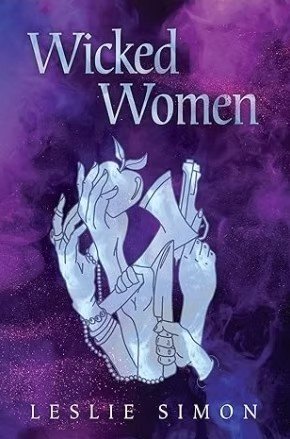
Last Sunday, I had the pleasure of talking to Leslie about her fascination with women of history, her approach to writing, and her many creative outlets. Leslie also talked at length about her poetry collection Wicked Women, and how her literary work explores themes of otherness, found family, and elements of the supernatural and macabre.
Most recently, Leslie Simon’s feminist op-ed ‘Dear Men’ was accepted for publication with The Medusa Literary Journal in Spring 2026. This will be available to read in the first edition of the printed publication, which will be available for purchase at the end of April.
M: Would you like to start by telling me a bit about yourself first?
LS: Hi, I’m Leslie. I’m an author, poet, and special effects makeup artist who enjoys writing about women in history and compelling true crime stories from the past.
M: When did you start writing?
LS: I’ve been writing my whole life. I remember when I was very young, probably six, I would sit at my parents’ computer and type stories about princesses. I started seriously considering being a writer when I was in fourth grade but shelved the idea for a handful of years to dabble in drawing and singing. Then, in my senior year of high school, my English teacher told me I should be an author, and I decided he was probably right.
M: So, you mentioned that you write every day. What does your process look like when you write?
LS: I always tell people I’m a poet, not a plotter. When I first started writing novels, I tried to plot everything in advance, but the minute I started typing, my characters went off script. Now, I tend to start with an idea first. Typically, I picture a couple of important turning points in the book, and write those first. Then I figure out how best to link those scenes together. It’s not the most efficient way to work, but it’s what works best for me.
M: You write about women in History: is there a specific reason for that or is that just something you picked up one day?
LS: I have always been fascinated with women in history, but I grew interested in “wicked” women after realizing that history’s female villains are more than the evil, seductive stereotypes they’re presented as in movies. There’s truth in the saying that history is told by the victors, never the victims. I wanted to change that.
M: So, you decided to give them a voice?
LS: Exactly! I approached Wicked Women with the question: In a world where men are the monster-makers, what makes women wicked? I ran with that idea and as I was writing, I discovered that where there was a grain of empathy, there was a fascinating story.
M: Do you approach writing poetry in a similar way to writing fiction? Do you plot it first?
LS: Yes, but in general, I tend to rhyme when I write poetry. My brain naturally thinks in rhyme schemes. For me, most poetry I write is either written from a place of anger or it’s a narrative poem that tells a story. This poetry collection was a little bit of both. There was definitely a thread of feminist anger woven throughout the collection, but each individual poem is also a snapshot into the lives of women whose stories have never been told objectively.
M: Isn’t it more of a constraint to write narrative poems instead of writing from a feeling? Especially, when you are restricted to a rhyme scheme?
LS: It can be. But I’ve discovered I like the challenge of telling a story that rhymes. I feel that it really pushes my mental muscles to figure out how I can tell this story the way I want, but in a way that sounds almost like a shanty. For this reason, many of my new poems are written with the intent of performing them aloud.
M: So, the new poems you’re working on are supposed to be poems that are listened to instead of read?
LS: A lot of them, yes. I have a background in acting, so I love the performative nature of poetry. I have found it can be cathartic to read your work aloud. Consequently, a lot of my more recent poetry is centered on feminist rebellion against the rise of red pill incel culture. There’s a delicious defiance in voicing the same opinions women voiced in ages past and knowing this time, witch burnings won’t silence powerful voices of change.
M: Do you do that? Is there a space for you somewhere to read your poems aloud?
LS: I usually record my poetry and post it to my Instagram platform. I love the connectivity of social media because it doesn’t matter where you are in the world, you can find poetry that speaks to you.
M: What does your support network look like as a writer?
LS: Most of my support comes from followers on the internet, people that are willing to pick through my rough draft rubble, or flip through my poetry, and offer a bit of literary insight. I’ve met a lot of wonderful editors and writers on the internet that I admire. Yet I do feel that it can be difficult to create a support network as a writer, especially in the BookTok sphere, because there tends to be a vein of competitiveness or jealousy between creatives. I find that mentality frustrating because I like to think of myself as someone who champions the success of all writers. I feel that every story is worth telling, regardless of follower count or industry demand.
M: What is your favourite and least favourite part about writing?
LS: My favourite part about writing is the initial spark of an idea, when you’re sitting there thinking, ‘this is going to be good.’ You haven’t written anything yet, but you just know that there is something special in that idea. The part for me that is the most difficult, because I’m such a perfectionist, is editing. I have the horrible habit of editing my work until it reads more like an industrial pamphlet than a novel. So, I often have to force myself to look at my work through the eyes of a reader, not a critic.
M: Are you working on something new at the moment?
LS: I’m always working on a bunch of projects at once. I’ve been working on a Bride of Frankenstein retelling set in Victorian London over the past year. I wanted to imagine: what if all the characters, from all the Gothic novels we know and love, inhabited the same world? What if they knew each other, and what would that look like? The main plot line centers on the Bride of Frankenstein, the Creature, and Dr. Frankenstein, with Dr. Jekyll, Mr. Hyde, Lucy Westenra, and Elizabeth Lavenza functioning as subplots. I really liked the idea of centering my story on women’s voices, because as I looked at Gothic stories, I realized none of the women featured in my novel are given a voice in the books and films they first appeared in. So, I’m centering my telling of their tales on rebellion and defiance.
M: I would like to go more in-depth into your poetry collection: So, how did you decide what poems you wanted to put into the collection?
LS: From the onset there were a couple of women who really sparked my interest. Marie-Antoinette, one of the most vilified women in history, has long been accused of being a vapid, apathetic snob. But the more I studied her, the more I realised, her real crime wasn’t frivolous spending, it was naivety. Similarly, Bonnie Parker, who has often been portrayed as an evil manipulative serial killer, was actually a desperate poet caught up in a whirlwind adventure that left her crippled, starving, and dependent on a vengeful lover beaten down by a broken prison system. Her story, more than any other, convinced me that most monsters are born from misguided fantasies.
M: Do you have a favourite poem of yours?
LS: Oh, that’s a tough question. It’s like asking me to pick a favourite child! The thing with Wicked Women is that I like every poem for a different reason. Even though each poem follows the same rhyme scheme, they all hold a different place in my heart. But the one I enjoyed writing the most centers on Eve from the Bible. I wrote it last in the collection, which felt rather fitting, since Eve is often credited as the mother of sin and each woman featured in the collection was accused in their lifetime of being sinful.
M: Are there any poets that you have read or are reading now that inspire your work?
LS: One of my favourite poets of all time is John Clare. He is a romanticist and Gothic poet whose work heavily inspires my own literary endeavors. I first encountered his poem, ‘I Am’ in a TV show called Penny Dreadful. Of all his poetry, I find it the most tragic because he wrote the first version from the comfort of his home and the second version from the drudgery of an asylum, and each version is a snapshot of his worsening mental health. I've also always been fascinated with Edgar Allan Poe. You would assume, based on how relevant his poems are today, that he would have been exceedingly successful in his lifetime, and the fact that he wasn't is what drew me to his work. In terms of novelists whose work inspires me, I credit: Jay Kristoff, for his portrayal of female heroines in the Nevernight series, V.E. Schwab, for her gut-wrenching magnum opus The Invisible Life of Addie LaRue, Markus Zusak, for writing my favorite tear-jerker into existence, and Justin Somper, who introduced me to the idea of taking popular tropes and weaving them together to create a grotesquely beautiful world.
M: Is there some sort of creative overlap between the special effects makeup that you mentioned earlier and writing? Would you, for example, create something at work that would inspire you to write a poem once you come home?
LS: All the time! I've always joked that - because of my background in makeup, acting, and art- I’m more capable than the average person of picturing things clearly in my head. That extends to makeup, as well. Due to my toolbox of peculiar interests, I’m able to describe split knuckles, Elizabethan makeup, Rococo wig styles, and slit throats with an attention to detail that exceeds most authors’ imaginations. Art, as they say, informs art.
When Leslie isn't writing, she can be found acting, modeling, doing makeup artistry, and singing. Her favorite characters to bring to life are those that reflect the unwilling heroes and tragically misunderstood villains she enjoys writing about.
You can find Leslie Simon on Instagram and TikTok @wickedwomanauthor