Talking Classics Review
The day before Christmas Eve last, I met a friend in Belfast for a few pints and as we migrated from the Sunflower to Maddens the conversation turned to him saying he had Stephen Fry’s version of The Odyssey on his to-read list, as that was the incarnation of it that he thought he could handle. This fella studied philosophy at Queen’s, by the by, but if you didn’t have a small to mid-sized fortune spent on your education (i.e. you’re a normal person) there’s always the sense of playing catch-up and certain media have a veneer of inaccessibility over them.
This seems to be the target audience for Mary Beard’s latest publication; she is not from a particularly ‘well-heeled’ background herself, but had a mother who read voraciously and took her on museum trips. It was on one such outing to the British Museum that her fascination with the ancient world began: she was too wee to see into the glass display case, and a wee bit too heavy for her mother to properly lift her. A staff member noticing this asked which item she wished a look at. She told him she wanted to get a look at the Ancient Egyptian bread roll, at which he happily opened up the case and held the mummified bap, near 4,000 years old and found in the early twentieth century amidst a layer of debris at a temple site in Luxor (purpose unclear, but probably interred with some pharaoh in case he fancied snack en route to the afterlife) before her awestruck eyes. Thus her career was born; anyone who has seen her classics ‘debate’ with Al ‘Boris’ Johnson will be acutely aware that passion beats privilege.
The first chapter is titled ‘A Sense of Wonder’ and one does get the sense that the wonder she experienced as a little girl looking at a small loaf measured in millennia has carried with her through her years as a student at Cambridge when she habitually annoyed her professors with the question ‘but what was it like to BE there?’ to being a professor herself. From Cambridge to California, trying to instil the cause of that question in her students; the same fervour is evident to in her various documentary serials.
This book has a particular interest for Irish readers in general, and for me in particular, via her references to ER Dodds, whose work The Greeks and the Irrational she praises as one of the most revealing works on ancient culture ever written, ‘still thriving in print after over seventy years’; and Louis MacNeice, for whom Dodds was not only a close friend but would serve as literary executor after MacNeice’s death in 1963. Somewhat serendipitously Beard quotes the same lines from canto IX of MacNeice’s Autumn Journal that I did in an essay published a few months ago in The Stinging Fly, albeit we arrived at entirely different conclusions.
‘And how one can imagine oneself among them I do not know;
It was all so unimaginably different
And all so long ago.’
Beard takes these lines of the section above at face value, and to an extent one can sympathise with why she does so. As she mentions in this book, she is always being asked which Roman emperor a modern day politician is most like: when asked that question about Trump, she joked that her go-to response was always a ‘Elagabalus,’ as the journalist who prompted her was probably looking for a response of Nero or Caligula, likely would have no idea who ‘Elagabalus’ was, and it would stop the conversation stone-dead.
However, I suspect the line is tongue-in-cheek (characteristic of this poet who also wrote of his Bishop father ‘My father made the walls resound | He wore his collar the wrong way round.’ The ‘And’ at the beginning of the line, carrying on from the complex descriptions of Ancient Athenian townsmen feels as if it comes with an eye-roll and a sigh: the poet has literally given us a how-to guide in how to Iimagine ourselves amongst the people of the great and distant past. Moreover, this is reflected in the rest of the long poem, which ebbs and flows, hither and thither and hither and thither, in a long, self-referential arc.
Written in 1938 (and a little bit in 1939 when it was published; due to be published a good while) Hitler looms large throughout as he ‘yells on the wireless’ which accounts for the ‘demagogues and the quacks,’ as does later reference to the 1938 Oxford by-election in which an independent left wing candidate faced off against the appeasement-supporting Tory Quintin Hogg, leading to the popular heckle ‘a vote for Hogg is a vote for Hitler.’ There is also an extent to which the riff of ‘demagogues and quacks’ is echoed again in, but in a much more personalised and raging tone, in canto XVI which deals with Irish politics:
‘The born martyr and the gallant ninny;
The grocer drunk with the drum…
…Griffith, Connolly, Collins, where have the brought us?
Ourselves alone! Let the round tower stand aloof
In a world of bursting mortar!’
MacNeice adopts characters throughout this poem, which he described himself in a letter to TS Eliot, his editor at Faber: ‘It is written in sections averaging about 80 lines in length. This division gives it a dramatic quality, as different parts of myself (e.g. the anarchist, the defeatist, the sensual man, the philosopher, the would-be good citizen) can be given their say in turn. It contains rapportage [sic], metaphysics, ethics, lyrical emotion, autobiography, nightmare.’
My advice to my friend, from the beginning of this article, who was unsure about getting into Homer (regardless of accent) was to remember that it is fundamentally just a poem. Words are not wine, they do not change in value with age. For example, via contrast, the works of William Topaz McGonagall become no less stultifying, woefully and utterly boring with each and every year they pass further into antiquity. This is potentially an instance in which John Green’s insistence that ‘books belong to their readers’ rings unequivocally true, as the value, the intrigue of such old, old works comes from how they are revived and recycled through the generations over centuries.
The survival of The Odyssey is evidence that art is fundamental to the nature of our species. As Green recently pointed out, in an interview to promote his latest novel Hollywood, Ending, our species was making art before we had a calorific surplus. Maslow’s pyramid is, thus, out the window. Emily Wilson, in her review of Christopher Nolan’s adaptation of her translation, argued that the success of the film — at a time when cinema going is in decline, as is, apparently, literacy — shows that there will always be a demand for stories in a world where humans exist. Stories are our most irrepressible, and least imitable, instinct.
We should also be conscious of the fact that every historic age has had a Media, much like our own: here meaning, there was good stuff, bad stuff, and popular stuff. Beard writes about lines from Aeneid that were so popularised they were graffito’d on walls; there were also sections that were so scandalous that they inspired a whole genre of artwork depicting a taken aback Virgil reciting them to an outrageous Ceasar Augustus and shocked Octavia who is falling out of her chair. Virgil’s very opening line, she argues, was scandalised for he begins by saying he ‘sings,’ rather than beseeching ‘the muse’ to guide him, as was the style at the time.
Beard makes this case for Sophocles’ tragedy Antigone which, though she points out the dated aspects, she writes of how it has been used symbolically by freedom and resistance movements through the twentieth century: Nelson Mandela, who took part in a staged performance of the play with his fellow inmates while incarcerated on Robben Island, wrote in The Long Walk to Freedom ‘Antigone… symbolised our struggle.’ He volunteered to play the tyrannical ruler Creon. What in Me is Dark, a recent book by Orlando Reade, examines how Paradise Lost was likewise used by figures throughout history as distinct and disparate as Malcolm X and Jordan B. Peterson, who each same some part of themselves in the character of Satan as personified in the poem.
Ironically, Beard makes it quite easy for us to imagine ourselves amongst the people of this past by showing us evidence of universal human traits that defy relegation to any one era. She presents us with the ‘Bar of Salvius,’ a pub in Pompeii where the walls were decorated with characters who were presumably based on regular punters with captions such as ‘you want a fight, you get outside,’ or ‘fellator.’ Although Beard admits she quite loosely translated the Latin for the purposes of making a little more sense in modern English, one can see a concurrent thread of humour - indeed, sheer silliness - that runs through humanity. It is not a grand stretch of the imagination to liken this long-gone tavern to some wee pub in the middle of Ireland that hasn’t had any more than a lick of paint since Sunningdale, and the walls of which are adorned with photos of various Friday nights that were rammed to the door; cuttings from the local paper; a wooden sign at one end of the bar that reads ‘Bullshitter’s Corner.’ MacNeice, as a well-documented ‘double-fist drinker,’ meaning a pint of stout in one hand and a naggin of whiskey in the other had probably seen more than enough pubs from Dublin, to London, to Athens, to recognise this.
‘Let you go back and labour | for Faber and Faber,’ sang Patrick Kavanagh, to the tune of ‘the Bard of Armagh,’ whenever MacNeice joined the company in McDaids pub, just off Grafton Street in Dublin. MacNeice, who was a good friend of Dominic Behan, was very fond of folk music and also fond of pubs in general and he utilised his knowledge of this scene as a channel with which to cast ancient stories in contemporary imaginations. His poem ‘Streets of Laredo’ which begins ‘O early one morning I walked out like Agag’ is effectively a cover version of the country song which has been performed by Johnny Cash and various others, rewritten within the bounds of the Book of Samuel.
Whereas MacNeice ‘imagined’ the crooks, adventurers, pedants, and cranks, Beard is showing us that they existed: existed alongside the mighty philosophers in their fine and flowing robes. She is showing us that not every day was an astounding day of ‘Eureka’ in the Agora; that the Forum probably had its days devoted to complex and tedious tax law as well, the debate held up by the older, but same auld, Healey Rae. The poet has the vision, and the historian shows it to us too.
Values are obviously different, between Modern Ireland and Ancient Rome; the politics are different according to day’s peculiarities. Though one could say the same thing of Modern Ireland and Modern England, and even their contemporary equivalents today. I am minded of the meeting that took place between Gráinne Ní Mháille and Elizabeth I, in which the two Queens spoke in Latin as it was their only shared language; at one point Gráinne needed to blow her nose and so she ask a knight beside her for the use of a handkerchief. He obliged, and him being a knight-of-the-realm it was an embroidered, silk article. The knight got the shock of his life when Gráinne, after blowing her nose, through it onto the fire; she looked at him in disgust and asked why on Earth he would want a soiled hanky given back to him. Which was a fair point, and for our purposes demonstrates how even contemporaries can have competing views of and in the world.
Humans as a species share common threads, though we resist homogeneity. Beard writes of Aphrodite of Knidos, a fourth century BCE marble statue by the Greek sculptor Praxiteles which became ‘the biggest tourist attraction of antiquity, at the town of Knidos, on the coast of modern Turkey.’ The original has not survived, but thanks to the survival of ‘dozens of full-sized ancient copies of it, as well as hundreds of miniature images on coins and small souvenir models,’ which attest to its popularity, it’s image is still knowable to us today.
What we can’t quite get, writes Beard, is just how scandalising the nude form of it was in its day. When we think of classical statues, we likely imagine them naked (albeit possibly adorned with a strategically secured fig leaf placed by a priggish Victorian) though most nude statues of the period were of the male form; the naked woman, particularly a naked goddess, was a ‘Shock of the Old.’ According to Beard, there was one young man who was so overcome by the undressed Venus - she is holding a washcloth, which serves as a pillar to keep the statue standing, and her hand is over her vulva, either covering her private area or directing our attention further towards it - that he tried to have sex with it, the leg of the statue bearing the mark of this for some time after.
Like looking into the face of a gorilla, the differences of Classical societies, which ought to drive a wedge between us, actually serve as an argument for the value of reading them: they remind us of the impermanence of the moment. In the same manner that light’s illumination is defined by darkness’ shadow. The bad times will not always be, and neither will the good: be prepared for better days, and enjoy them while they last, wary of their inevitable dawn. As MacNeice wrote in the closing canto of Autumn Journal:
‘Time is a country, the present moment
A spotlight roving round the scene;
We need not chase the spotlight,
The future is the bride of what has been.’
And ending with the lines…
‘On the banks of the Rubicon — the die is cast;
There will be time to audit
The accounts later, there will be sunlight later
And the equation will come out at last.’
CS Lewis, via the demon Screwtape, advised us likewise when he wrote that humans are naturally aware of the ‘undulation’ of time — the seasons being a pretty regular occurrence, not to mention the repetitive waltz of dawn and dusk. Our demons, or perhaps rather, our worst instincts try to make us forget this: lulling us into a false security that bad will never get better, causing our resignation from the whole affair, or worse that good will always be good, making the next downward trend all the more impactful and devastating.
Rather than imagining myself in Ancient Rome (there’s a good chance I’d be dead by the ripe of age of 10 anyway) I imagine an Ancient Roman among us.
Imagine the Eleventh Doctor can do what he did for Vincent Van Gogh, taking him to Amsterdam in the present day to witness a portion of the recognition he never received in life. The Doctor journeys an Ancient Roman to our age. What would the fellow think of how his homeplace still captures our imaginations so much that we make memes about it? (Someone would have to explain to him what a ‘meme’ is)
I suspect that his reaction would differ according to his class: Augustus might fall into a deep depression to see the ‘city of marble’ he built up from a city of wood, laying in ruins in the middle of a capital of some unrecognisable state in the middle of a continent of equally unrecognisable, and tiny, other states; a slave, I suspect, would be more stoic, and even bemused by our attachment. The key word, and the interactive instruction, is: ‘imagine.’
One can argue that in Autumn Journal, MacNeice is using Classical references as a lense for viewing the chaos of the contemporary scene: the London parks, an ugly sight, being dug up in favour of the war effort. To an extent he is doing something similar to Edith Hall in Facing Down the Furies. Hall’s is a rare and fascinating study of intergenerational trauma in the aftermath of suicide, for which she is uniquely equipped to write on: the previous three generations of her families all killed themselves. Hall writes a beautiful weave that is part-memoir, part-narrative of the ‘blood crimes’ committed by legendary characters, leading to them being hounded forevermore by The Furies (not, you understand: the ballad singers).
Studying Classics and thereby pondering ages so far removed from our own, is akin to staring into the face of a gorilla. At a distance a great brute of a creature with no semblance of similarity to ourselves, until one sees the eyes, and from there all differences merely enhance the similarities and the portrait transposes itself into a mirror.
Study of Greek mythology makes us canny to undulation, as right at the birth of the Universe, ‘order’ was created alongside ‘chaos,’ just as ‘dark’ came about alongside ‘light.’ That everything has its opposite number, opposing force is recurrent. Classics remind us that though eras end, empires fall, and new orders rise, there is a wonderful spark of permanence to humanity, to people themselves. My favourite lines of Autumn Journal come from canto XVII, where MacNeice is in philosopher-mode, floating in the bath watching the rose geranium soap make clouds in the water:
‘Why not admit that other people are always
Organic to the self, that a monologue
Is the death of language and that a single lion
Is less himself, or alive, than a dog and another dog?
Virtue going out of us always; the eyes grow weary
With vision but it is vision builds the eye;
And in a sense the children kill their parents
But do the parents die?
And the beloved destroys like fire or water
But water scours and sculpts and fire refines
And if you are going to read the testaments of cynics,
You must read between the lines.’
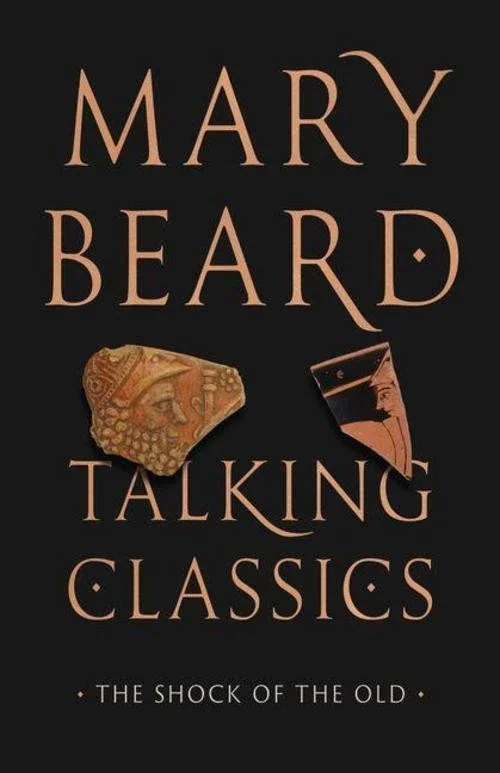
Talking Classics by Mary Beard
The University of Chicago Press
© 2026