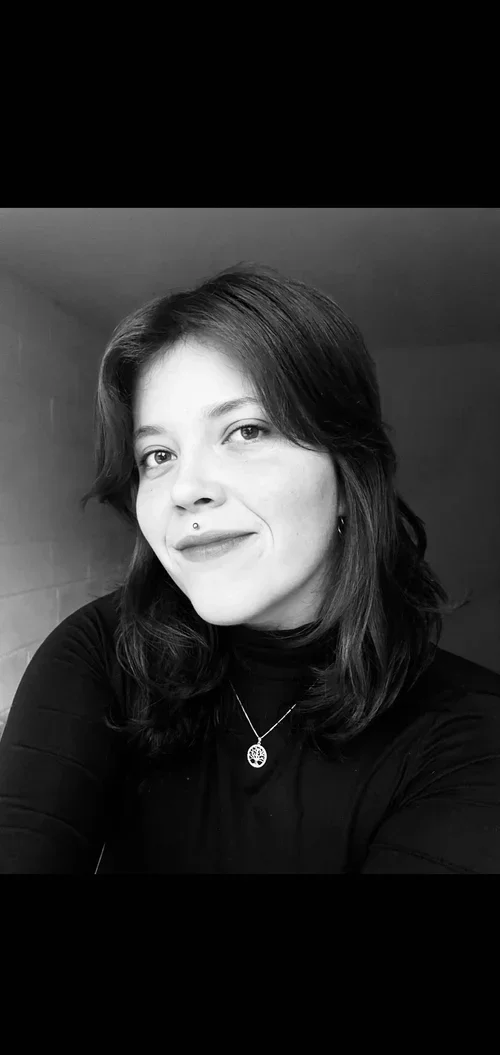
Eoin Ryan on: Connection Through Music
LC: Could you start by telling me what instruments you play?
ER: I started out with acoustic guitar and that’s predominantly what I play, but I also play electric guitar with Bitcrush! and I sing of course. I love playing bass as well, I play bass for my friends’ bands and such, and I played bass in 50 Foot Woman for years.
LC: What’s different between playing alone and playing with Bitcrush! ? Do you prefer one over the other?
ER: Starting off playing with Bitcrush! was a bit difficult because I’d never played lead guitar in a band, and I was also recovering from tinnitus due to my years of playing loud music, so that was upsetting and hard, because Bitcrush! are an extremely loud band. What we lack in talent we make up for it in noise and ferocity.
I’ve found it’s way easier to make a fool of yourself, to let go and just perform physically with Bitcrush! because there’s a lot to play with, it’s a great way to connect to people when you’re on stage and you can jump into the crowd. I crowd surf in most gigs because it’s really important to get down to people’s lives and just get them involved. Movement is an underappreciated part of community engagement I think, especially in the West, like rituals and practices of community movement is something that can really bring people together. I find that gigs are great examples of that, moshing but also the respect form that you should have in mosh pits. When somebody jumps out into the crowd, the assumption that they’re going to be carried by the people who are moshing is an essential part of the show, the crowd becomes part of what the band is doing. It’s a collaborative experience, and that’s quite therapeutic. I always try to make sure when I’m playing with Bitcrush! that we’re giving as much of an opportunity for people to physically engage themselves as possible. With solo music it’s different, it’s a lot softer.
LC: What’s your favourite thing about the Irish music scene?
ER: My least favourite thing is that it’s so Dublin centric. We have great scenes and great bands in Irish towns, there are hidden gems all over the country but it’s a shame that it’s so Dublin centric, because you’d chat with Dublin bands and they have no idea what’s going on outside of Dublin. My favourite thing about the Irish music scene is the indigenous nature of it, it’s the fact that it always comes back to sounding quite folky, it’s quite rural and community based. I like when the language is used in an ironic sense, or a modern sense. I love the history of Irish music in terms of it having been spread all over the world and now it’s beloved even by people who come as far as Japan every year for the Willie Clancy Festival. I think it’s great that it’s such a small country as well, so if you’re a modestly successful musician in Limerick there’s a chance that somebody up in Dublin might know who you are as well. We’re all appreciating each other from afar.
LC: What about the Limerick scene specifically?
ER: The Limerick scene is cool too, there’s always a good rake of bands that come out of there every year, and we have some really nice bands and promoters: Seth Collins is doing such a good work for gig promotion in Limerick with Wombat. The only issue is that it’s becoming a little harder to sustain scenes because there’s only two venues, the Record Room and Pharmacia. They do a lot of work, and we’re really privileged to have them but it’s easy to become burnt out of a scene when you’re always going to the same two venues. That’s why I think it’s good to open up new spaces like The Tavern or Lucky Lane, even street corners. If we focus a little more on making a broader school for gigs in Limerick then we could really sustain bands to stay here, because the unfortunate thing is that Limerick has a time limit for young people. It’s a very liminal space for people who are above 23 and below their mid-thirties, for that very crucial ten years period Limerick doesn’t have a lot to offer. I feel like that applies for creative careers too, we need more venues that are readily available and cheap to rent out to sustain scenes, so that they don’t just burn up in a cloud of smoke after a few months. Because when it’s good it’s good, but when it’s gone it’s gone.
LC: If you had to give up one between writing and playing music, which one would it be?
ER: This is a terrible answer but I’m going to say writing, because I think music is extremely therapeutic, I’d love to work in music therapy or community music. This is going to sound like such a performative male (laughing) but I’ve been reading this book called Decolonized Minds by Talha Alali: he’s a Palestinian writer based in Dublin, and it’s about how important group singing or group dance is for getting over trauma and redefining your trauma from indigenous context. That’s really important too, everybody likes to go and let off some steam in a punk gig, right? Everybody likes to go and listen to their favourite songs and shed a tear because they’ve had a really rough day. I think playing music is something that is so important for everyone, you have to get out of your skin and let go and dance a little, make a fool of yourself and be emotional. I’m not giving that up for anything.
LC: How did you even start getting into music?
ER: Tale as old as time I guess, my parents are both very much into music, and the first time I remember enjoying a song was being four years of age: Mojo magazine had released a collection of Ska hits and they played Skinhead Moonstomp, my parents had that and I remember just the tune of it, I used to sing and dance on the kitchen table. So that’s how I got into music, then at age twelve I started getting into The Cure and Interpol and such, and I started playing in bands when I was fifteen. It’s been natural since then.
LC: How did you start songwriting?
ER: Music Generation in Limerick is vital for that. It’s funded by U2 and the government, and every Saturday it offers four hours of rehearsal space for free in Limerick for teenagers. Teenagers can go there, meet people, jam out and form bands. So, there’s this huge thing of the Music Generation bands, that’s very common. I used to go there every Saturday, and they would do songwriting sessions and workshops about how to write a song, or how to get over the barrier of writing your first song. I never thought of writing songs until then, and I haven’t really stopped since. I was about 13 when I wrote my first song, the lyrics were terrible but your first song has to be your worst one.
LC: What’s your process for creating a new song? Do you start with the lyrics or the tunes first?
ER: I start with the tunes really, I find it’s much easier to write poetry by itself but I find it hard to write a song from a word because I’m not a very rhythmic kind of person. I think Lionel Richie said something about songwriting during a talk-show, he started stomping his hand on the desk rhythmically and he said ‘you’re not really a songwriter if you don’t feel the need to sing over this.’ I disagree in terms of having many different ways to write a song but it’s true at the same time. That’s not the way I write songs, I’m not really in tune with rhythm, I couldn’t sing over a beat but I love writing lyrics over acoustic chords, melodies and structures I made on my guitar. So that’s how I do, I’m focused on my electric or acoustic playing and just write poetry over that.
LC: Speaking of inspirations and influences, any artists you look up to?
ER: Oh yeah, in terms of contemporary artists I think Karly Hartzman has been one of the coolest songwriters ever, she’s the singer and guitarist of the band Wednesday, she’s so awesome. In the same way I’d also say MJ Lenderman, in terms of international young bands he’s such a funny man, he’s like Gen Z’s Neil Young. As to Irish bands I really look up to Meg Lowney, she’s a phenomenal singer and songwriter, she sounds like Adrianne Lenker from Big Thief. I look up to Tom Waits a lot; he’s my favourite of all time I think. Post Punk Podge is the GOAT of Limerick, and I’m a really big fan of The Caterers, it’s a really cool young band. People in Ireland probably never heard or went to these gigs but I look up to all these people.
LC: What song would you recommend for people who would like to discover your work?
ER: For Bitcrush! I only joined the band somewhat recently – about a year ago – so I actually haven’t played that much but I’d recommend our song Jezabel. My friend Garbhán wrote that, the singer of Bitcrush!. He’s a phenomenal songwriter himself; it’s a great weirdly psychedelic indie pop song. From my own solo music I would recommend my new song, ‘Show You My Love’. It’s definitely the style that’s most relevant to me now, and the beside was to make my mother proud as well by using Irish in music.
LC: Do you have a favourite song that you wrote? Or a least favourite one?
ER: Well I have a lot of shitty songs that have never seen, nor will ever see the light of day, but I can’t publicly say my least favourite song (laughing). There’s one, not that I think it’s necessarily a bad song, but I’ve dropped my most popular song from my setlist: ‘When It Rains’. I wrote it when I was sixteen and I feel like it’s a little bit outdated, I think I’ve moved on from it. Whenever somebody says that it resonates with them it’s always nice to hear and I appreciate it; but for me it’s just something that I played to death for a while when I had nothing else going on, so that’s one that I just leave to the Spotify. But people obviously like it, and I’m really thankful they do. My favourite song is probably ‘Twin May’, I wrote it when I was fifteen and it’s about my mother, because that was her nickname as a child. I only called it after her because it was the recording of the first verse I wrote when I was fifteen. I was trying to get my mam to listen to it, and she just came into my room and went ‘it’s the best one yet.’ And walked away. I’d say that was a sweet one, it always reminds me of my grandparents in Kildare. So that’s why it’s my favourite, it’s a personal and powerful song.
LC: Any advice for someone who would like to start writing songs or music?
ER: Never be afraid to reach out, there’s a bit of a culture of celebrity surrounding local artists or whatever, it’s so like ‘yeah I’m in this band and I’ve got this cohort of fans’, but these people are just like you and me. They are just people who like making music. So never be afraid to reach out to people, just talk or be friends with many people who are creative. Never devalue yourself in that way as well, just because you might not have played a lot of gigs yet, or you might not have released a lot of music by a certain age. You should do it because it’s something you have to do. I think just being kind to yourself and doing as much as you can in that capacity is important, because I think it’s better to write a lifetime of shitty music than writing nothing at all. Your voice is important.
LC: What projects are you currently working on?
ER: Me and my friends Liam Butler and Mark Cusack are bringing back this pub called The Tavern in Limerick, it’s a lovely spot. We’re doing monthly folk sessions there that are inviting anybody who is interested in songwriting or performing. This one puts an emphasis on original music, so people would write their own songs and it’s a full set of 30 minutes rather than two or three songs that you’d play at an open mic. This is basically just trying to empower people who maybe aren’t as confident or who haven’t had the experience of playing live. We’re just trying to get a community of people, to get poets involved with musicians and musicians involved with artists, and with people who want to promote gigs. It’s all about creating unity and a space in Limerick. That sentiment is the reason we’re doing the Tavern sessions.
Me and my friend Vinnie are also going to release a hyperpop album, which is completely out of field. It’s good craic to be honest so I look forward to that. I’m also recording a mini album with my friend Garbhán over the summer. It’s a lot more centred on death and mortality on this record, so it will be interesting to see what people think of that. Bitcrush! also want to do a live album so people can get a taste of the zanies you know. I’ll probably have a few pints as well.
LC: Where can we see you perform?
ER: The Tavern, Pharmacia, Record room, or the streets in Limerick. I’m doing the Music Generation Festival just to give back all the help they gave me as a teenager, and Bitcrush! might play to support that. We’ll also play in Oxford when I’ll be on Erasmus there, and we want to rent the Irish Centre in London and do an Ennis takeover. I don’t know how realistic this is, but it could be good. I don’t have any aspirations of fame or fortune because that’s just stupid, no one cares; but I just hope I can get Bitcrush! on a good tour and we can play some more gigs this year, and while we’re gigging I hope we can kick up a fuss and get up a few people’s noses.
If you are interested to find out more about Eoin you can find him on:
Instagram: https://www.instagram.com/eoin.ryan.3386?igsh=MW9ncDk4dXp4anBvaQ==