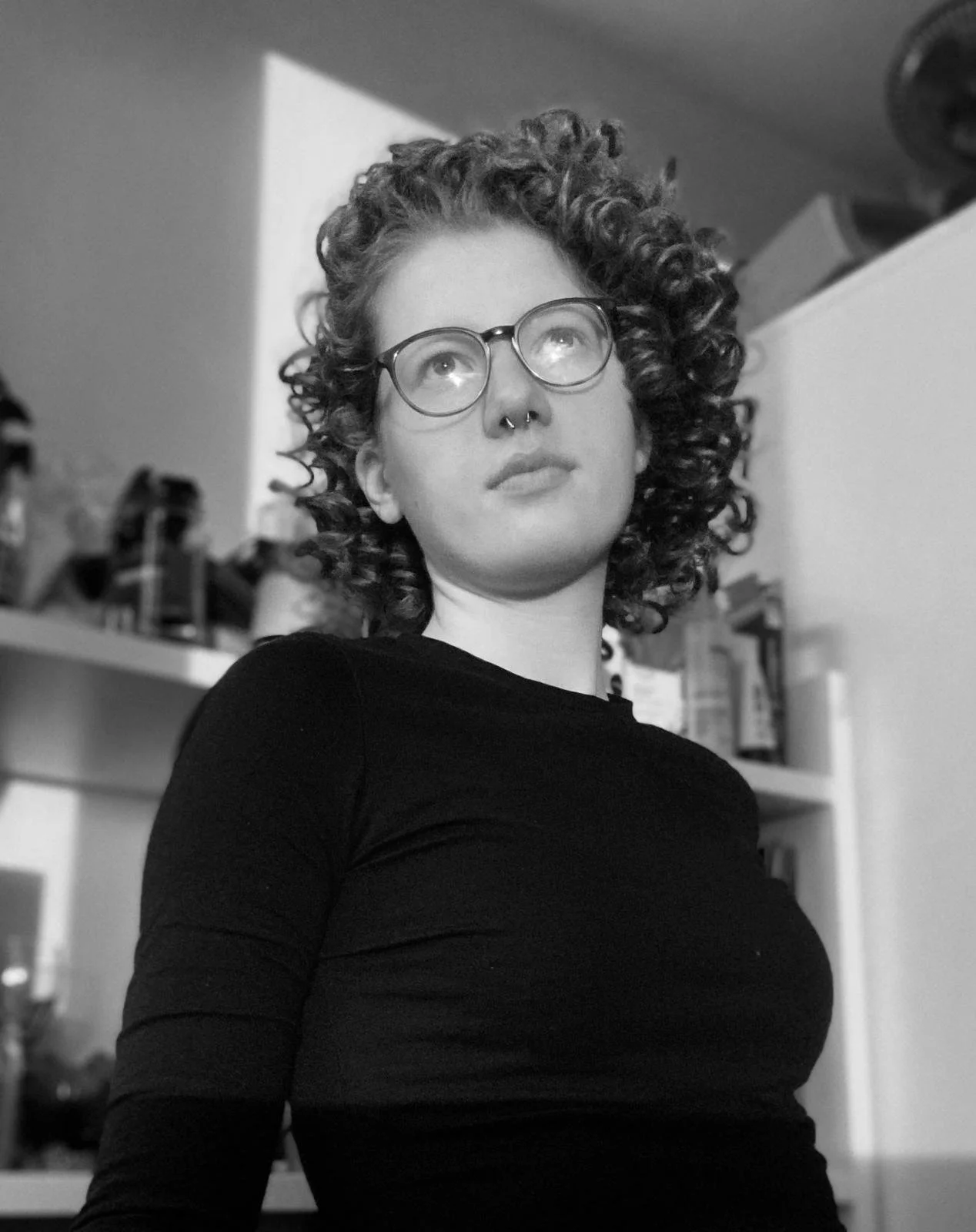
Dave Rudden Welcomes you to the Rising
MM: The first question I had for you is: if you were a character in a book how would you describe yourself to others?
DR: That is a great question, I would probably use my own descriptive strategies - I would pick out two or three details and let the reader do the rest. I would talk about how I have the energy of a corgi trapped in Christmas lights. I would talk about the expressive arms, and the general sort of technicolour vibe of the big red hair, and the loud voice and the constant movement.
I think as a third detail I would maybe zero in on the great interest I have in people. I worry a lot about the fact that I talk so much but I think it's balanced out by the fact that I would much rather be listening to people. Whenever I meet somebody, I find them immediately incredibly interesting and I want to dig into their entire life and back story and career.
I sort of skip the small talk and go straight into the invasive surgeries of conversation and I hope that balances out how often I am on transmit as well.
MM: How did you get into writing? And when did you first start writing?
DR: I first started writing in school. It was the only part of school that I found really interesting. I was the kid who wrote five pages for a two-page story, to the point where my teachers were quite frustrated!
I have always had a very complex and overpopulated internal life, and I’ve always been a storyteller. I had forgotten this, but a very close friend of mine told me that when she started school I was already known for gathering the other five-year-olds around at break time and telling them stories.
But it was only when I studied English in university that I thought more about writing things down, as opposed to simply performing them. The storytelling has always been a close companion, but the medium has changed. At the minute I prefer novels because you have a lot of room, and I love description. But I also diving into screen writing, poetry, or acting, anything that can convey a story really.
MM: What is your favourite part about the writing process?
DR: My favourite part about the writing process is the second draft. I really struggle with first drafts because I struggle with creating something from nothing. What I love is going back in and looking at this messy sketch and choosing the lines that will stay until the end.
I love the feeling of carving a proper, defined something out of a shapeless blob, which is what my first drafts look like. It feels to me like winning the argument before you have it. Like a great trick. Like I'm getting away with something.
MM: You did Children’s fantasy, and then Doctor Who and now with Sister Wake you dabble with adult fantasy so how does it differ for you writing to those specific types of stories?
DR: For me it is always about the audience, I think of myself more as a performer than an artist. I don't think you are any less of a writer if you want to keep your writing to yourself, but for me writing is about pursuing that connection with a person or a group of people.
So I don't necessarily think about age groups until we get to the marketing and publishing side, who are obsessed with that kind of thing. I'm always thinking about who I'm talking to, so with Knights of the Borrowed Dark I was talking specifically to that troubled, too genre-savvy for their own good,12-to-13-year-old who has started to recognise all the connections between all the books they've read.
With Doctor Who it was very easy: you're talking to Doctor Who fans. But even within that there's a spectrum, there’s casual Doctor Who fans, and then there's people who are less casual about it.
With Sister Wake I was speaking to adult fantasy readers, people with one foot in a love of history, and I was also specifically trying to capture my own feelings and understanding of Irish history – how much of it are you supposed to carry with you, how much should it weigh on your daily life?
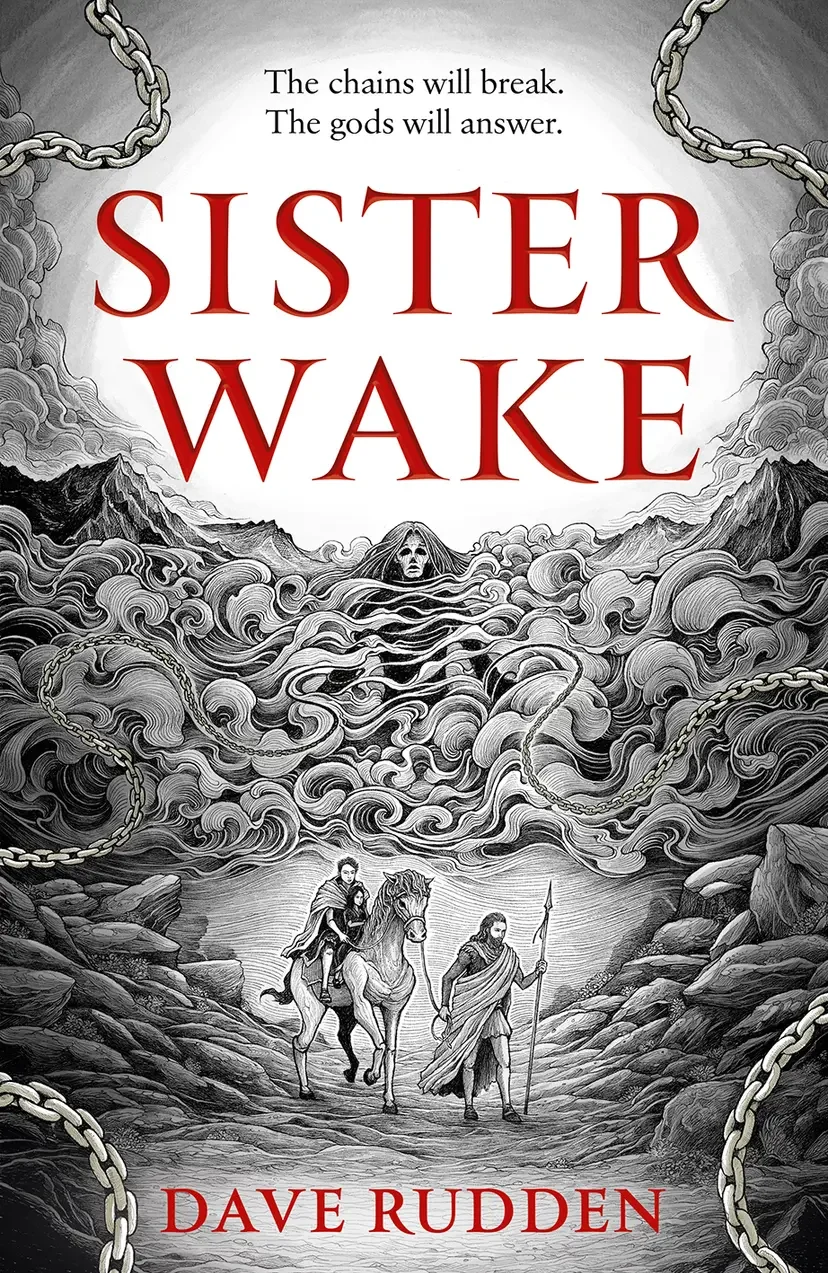
Sister Wake Cover, Hodderscape 2026
MM: So how did you go about setting up the story of Sister Wake?
DR: I don’t like mystifying writing. It's a job. Even if you're very talented and it's very natural you still have to make it work.
But I've been very lucky in that for my two big trilogies the first chapter came to me fully, with the main character totally already established. I already knew exactly who Sister Wake was. That first chapter has barely changed over ten drafts – that’s her.
With a lot of characters, I have to work very hard to get into their mindset. With Sister Wake and Denizen from Knights of the Borrowed Dark, I know them. I wind them up, I watch them go.
What followed on then was a much more complicated process. I knew there would have to be other perspectives in the book because I wanted to show all the different factions on either side, I wanted to show the overlap - the watercolour of history. In any story of colonisation there’s integration, there’s separation, there’s blending – sometimes intentional, sometimes not.
It also had to be a good, propulsive story!
Essentially, I learn by drafting. I wrote a very messy first draft and I kept rewriting it and rewriting it. What really made it go into overdrive, and I don't think I actually recommend this, is that we sold it on a partial. We sold it on the first 40,000 words, and then I was like ‘oh, I really need to get my shit together now, because they're expecting the rest of it.’
One big change was that I had been planning a 200,000-word book and when Molly Powell at Hodderscape bought it she said that Fantasy was trending more towards 120,000 words. So I ended up covering the same ground as I had always planned, but in a more straightforward, pacey way. It was a very iterative, very collaborative process with my publisher.
MM: So you always knew that there had to be three voices of main characters that would tell the story?
DR: Absolutely. I knew I wanted to capture the cultural disinterest that you can still see in some people in the UK. Their history is so intermingled with Ireland’s, and their history is responsible for a lot of our history, but because it’s not taught, and because there isn’t a focused interrogation of it, a lot of people just don’t know anything about it. That leads to a sense of defensiveness and privilege.
I wanted to give a character that dilemma. I also wanted to have a character who believes themselves entirely outside of this conflict, to highlight the lack of understanding of nuance you can have when you’re just a little removed from something.
I also wanted an eye or a camera on the intrigue at court, on the privileged and the rich and powerful as opposed to the more grassroots side of things with Sister Wake.
‘I was a sacrifice,’ [Sister Wake] said, and bared her manacle scar. ‘And the Cailleach made me a saint.’ She smiled a dead smile. ‘What will she make you?’
Sister Wake, p.50
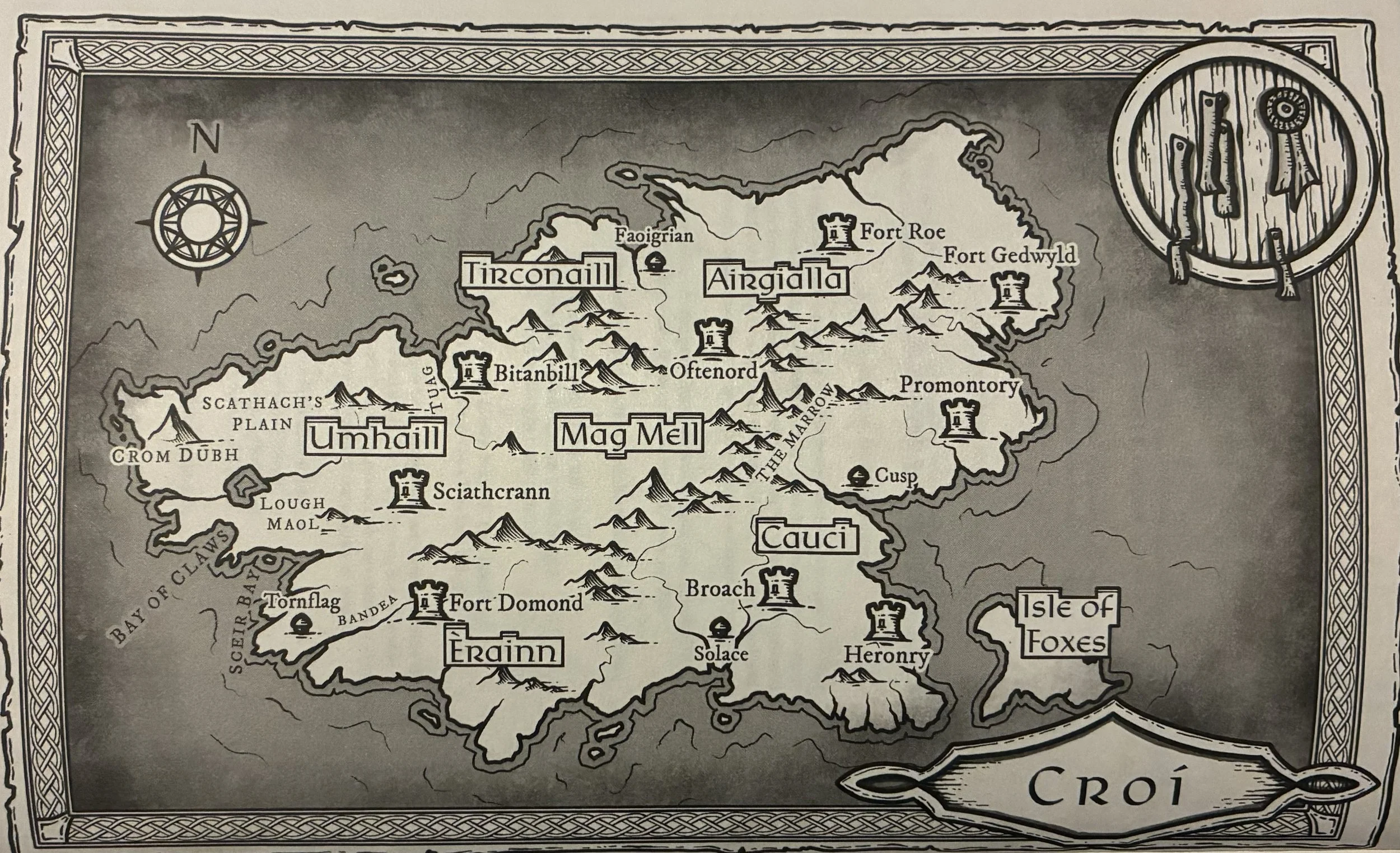
Map of Croí, Sister Wake
MM: It’s quite obvious that Croí is modelled on Ireland, how did you go about trying to incorporate that into your own placenames when you drew the map and named things?
DR: With great care. It is funny that there's a Goodreads review of the book that is like ‘oh it's just very clearly Ireland in England.’ And I was like ‘Yeah. That's on the back of the book.’ I'm not trying to hide it.
But I was also very aware that I was handling something precious. I was born four miles away from the border with Northern Ireland. I studied history. I have done an awful lot of research, (which only tells you how much you don't know) and all this basically just taught me that I will never have the same level of knowledge as somebody who has made it their life's work.
So, it was a slow methodical process of making choices, making sure those choices were not instinctual but in fact coming from a place of intentionality and research. I run them past two extremely clever and well-studied people – an ecclesiastical medieval Irish scholar and a professor of Irish and science fiction.
You can accidentally stumble into a meaning or nuance, but I was always trying to make sure that whatever I was doing, I was doing it on purpose.
I was also very careful to stay in my lane. For example there's an online narrative that the Irish were slaves, and we weren't. Putting that in the book or fictionalising it for extra impact or pathos would be claiming something I don’t own. There’s enough in our own history for me.
There have been people who have emailed saying ‘You make the invading empire look very bad’ and I was like ‘Well I just opened a history book.’
The Answermen came, and it was not enough to take the land and the trees and the meat and the bread, but you reached inside us and cut out our laws and language as well.
Sister Wake, p.59
I think one of the things that is fantastic about fantasy, and I get this from Terry Pratchett who's my favourite author: Fantasy can be used to play out an old argument or an old innovation, but with new and fresh eyes. He does this in Men at Arms, he invents a gun. Guns have been around for very long time, but he gets to rehash out the argument when his first gun is invented, and what it does and what it changes. That's some of what I wanted to do in in Sister Wake.
On the other side, you have to be open to learning when you're wrong, learning when there is an interconnected aspect of history that you haven't considered, and incorporating that in going forward.
One of the things I went back and forth on was the use of Irish at all, and it was only when I spoke to Children’s Laureate Patricia Forde and other native Irish speakers, and they were shocked that I was worried about it.
They were like ‘Well why wouldn't you? Don’t we use English all the time in fantasy books like why wouldn't you use Irish? Why don't we get a go at being a fantasy world?’
I took that on board, while still being aware that that's not everybody's opinion. Careful progress is my watchword.
MM: Was there ever, in the process of making this book, someone else who read it and considered that it might be too Irish or too on the nose of being a conflict between England and Ireland? Did that ever get back to you in a way?
DR: I think that that's the thing that you have to consider when you're writing historical fantasy, because the more specific you make something the more chance you have that it will be the specific thing that somebody maybe isn't interested in or doesn't like, and it is its own sub genre of fantasy.
You have things like The Poppy War or Shauna Lawless’ books, which in various increments cleave quite closely to historical events and I think you do run the risk of readers maybe not having an interest, or readers having too much of an interest, where they already know it so well. But you also run a risk every time you make a definitive choice when you're writing, and I think the universal writing rule – if you want to elevate your writing – is to be more specific.
Anybody can write a story where a character runs through a forest, but the real meat of that scene will be in the way it is described: is it a tropical jungle, or a temperate rainforest, or a temperate forest in northern Europe? Is it a frozen run of pines where you get the smell every time you step on them?
I always tell people in my writing classes that you have to find your heat, the one thing you know about that no one else does, and then through good writing you make it the thing that people care about.
For me the excitement of this book was bringing what I know about Irish history and this particular conflict to a fantasy setting. It wouldn't be the book without that.
While there was pressure on me to do it right, there was never a thought of leaving it out in the hopes of appealing to a broader audience. That's not the book I wanted to write, so I think that if I'm leaving people outside of that experience then that's okay, not every book is for everybody.
MM: Irish as a language is not as well-known as people might expect it to be, so were you ever worried that people would pick up this book and not know about it and think you made it all up?
DR: I guess I didn't worry about whether people would think I made it all up, but that could be my own bias as someone who's grown up with the language, I could recognise it anywhere.
There might be people who read the book and think ‘Oh, this is an entirely fictional place.’ Which it is, technically. My agent is based in London, and when we were going out with the book I did ask her ‘Am I shooting myself in the foot writing a book about English colonization and then going out to English publishers?’ and she was like ‘They won't get it.’
I think the key to writing something with a real world theme at play is that it has to stand on its own two feet without a deep and intimate knowledge of that theme. You can't be preaching from a pulpit. you shouldn't have to have read a book on Irish history to enjoy it. If you have to, I sort of failed as a storyteller.
I come from the tradition of standing up in a smoky pub and telling stories at open mic nights, and if you have to spend half an hour explaining the context of your story you've lost the crowd.
It's all about theme in motion, it's all about the idea that characters, when they live in a fantasy world, don't stop to think ‘I make my bread this way because 200 years ago…’ They just think ‘I'm making bread.’ It has to feel real to them and then hopefully you can tag along for the ride.
MM: I think Mike McCormack said that once to us in class, he said ‘You do lots of research on the book you're writing and 10% of that research makes it in a sort of an afterthought.’
DR: Yes, exactly. I think you're trying to get to the point where you have the same lived-in knowledge as your character, and then when your character puts on their léinte or eats a bowl of whey with milk you can almost imitate it.
But you will know a lot more about the process and unless it's interesting, which Mike McCormick does so well with process, there's not much point in putting it on the page.
MM: Going back to your three main characters, which one of those are you most like?
DR: That’s a great question; I’m about halfway between all of them because I am an actor playing these three roles. Sister Wake’s contrary, belligerent – shortsighted at times – compassion is very much a part of me. Abelard is this sort of soft boy neurodivergent careful clumsiness, which is very much me.
[Caspar] gave Abelard a wary frown. ‘Not that she’s pagan or anything. That’s a hanging offence, is it.
‘Is it?’ Abelard asked. ‘I didn’t know that.’
Sister Wake, p.32
And then Talasa who's watching behind 5 panes of glass and thinks she is so aware of what she's doing but is missing things all the time.
‘Women were ever the secret keepers and storytellers, the hidden sinew that dictated a society’s reach and grasp. Men could kill each other, but the reasons they did so fell from their mother’s mouths. Even the Answering knew of this, in their own dim, self-centred way. Talasa had seen the sneering illustrations – hunched-over crones in dank huts hung with dried roots and jars of eyes.
Knowledge made women monsters. That was the message. Power made them ugly.
Sister Wake, p.144
My friend Adam described Talasa as a program trying to be a person and I think that's how I feel a lot of the time. I do find Sister Wake easier to write, because she's just a force of nature but they all have their joys.
MM: So of course there will be two more books, do you have any idea on when we will get the next one?
DR: Well, I can't give you a date. I'm not supposed to be doing that. But… let's call this a world exclusive: the second book will be out in the first half of next year. I'm going to take a little bit more time with the third one, but not another fantasy author’s amount of a little bit of time.
It is all plotted, I know exactly how it ends, so I’m just rattling along. And then I’m going to take a huge break and play a lot of video games.
MM: It's good I think for you that you know how it ends.
DR: I'm always like that, from when I started writing Knights of the Borrowed Dark I knew what the final line was.
With this trilogy, which we’re now calling the Imperfect Vessels trilogy, I always knew the frame of the ending because it's based on Irish history, so there's no neat ending to colonialism.
While there are still little plot bits on the way that might move around, where the characters end up and what I feel needs to happen for them has always been clear in my head.
Characters for me are kind of a question and answer. They're an arrow shot from a bow, and you usually don't shoot an arrow without knowing where it's going to land.
MM: Will there be more gods in the coming issues of the trilogy?
DR: One hundred percent! The gods are my dessert when I'm struggling to manage time between different plot lines, or when I am struggling to keep a large-scale battle in my head. The one thing that I've always been very good at, the one thing that I can always rely on for a nice morning, even in my Doctor Who stuff and Knights, is sitting down and working on a creature.
Whether it's the texture of their skin or a tiny detail of sadness (because you can't just have a horrible monster, there has to be like a little bit of tragedy or a little bit of hope) I love it. I can spend my whole life just doing that.
I should write a bestiary, just writing monster after monster after creature after creature, that's my real joy. Do you have a favourite creature or favourite thing in Sister Wake?
MM: I like the goddess of war, Macha. She's very impressive, and I think it's so cool because she's so large, and she has this limp of the injury she had, and that's such a cool detail because it doesn't take away from the power she has even though she is technically hurt.
DR: Yes, if you look at large, long-lived animals they will always have these scars and these limps and even infections for their entire life that don't heal, but they keep fighting regardless. Sovereignty in Croí has always been a thing that has been wounded and under siege, so that's my favourite detail about her too.
That and her sword, which is the length of O'Connell Street.
MM: She appears on the page and immediately you feel very, very small.
And beyond that terminator line of dead bodies, above the field of viciously yellow weeds, was Macha. She did not obscure the sunset, she was the sunset – a living eclipse of flesh that took the sun away with every swaying tramp of her feet. Her enormous hands clasped and unclasped at her sides. The evening was so cold that she strode through a constant smog of her own furnace face.
Sister Wake, p.441
DR: Good, thank you. Large monster media or Kaiju media is a lot easier to do with pictures or with film, so doing it in a book I really had to explore and try and embody that feeling of smallness and helplessness.
The first of the new Godzilla movies, the 2014 one, would always put a human in the shot every time they showed you Godzilla so you always knew how big they were relatively, which I think is really important because it can't just become an image.
When you're writing you have the opportunity to bring in smell and sound and the viewer's own body, so I try and do that a lot so you feel the proximity in every one of your senses.
MM: Yeah, and I think what makes this god specifically so scary is that there are no rules for them, you could ask them for help and they might help you but they also might just step on you.
DR: That is something that will be explored more, and I think also a very important facet to talking about religion and empire is the inconsistency - the idea that if I do what it asks I'll be safe, and that's not true.
‘All blessings are curses, depending on how you look at them,’ Netha said, and the sailor nodded. ‘Croí gods are capricious folk.’
Sister Wake, p.105
If you want more information on Dave Rudden and keep up with Sister Wake you can find it on:
Instagram https://www.instagram.com/daveruddenwrites
His website https://www.daverudden.com/